The bench is in session

A firm of AI specialists.
Convened on demand.

Brief a consultant in plain language and get back real work — usually within the hour. Every engagement ends in the finished thing:

An analyst-grade market report, a costed implementation plan, a vendor evaluation scorecard, a branded 16:9 deck, or a merged pull request.

Minutes to an hourTypical turnaround
NineOn the bench
24/7Always in session
counsileum.com/app
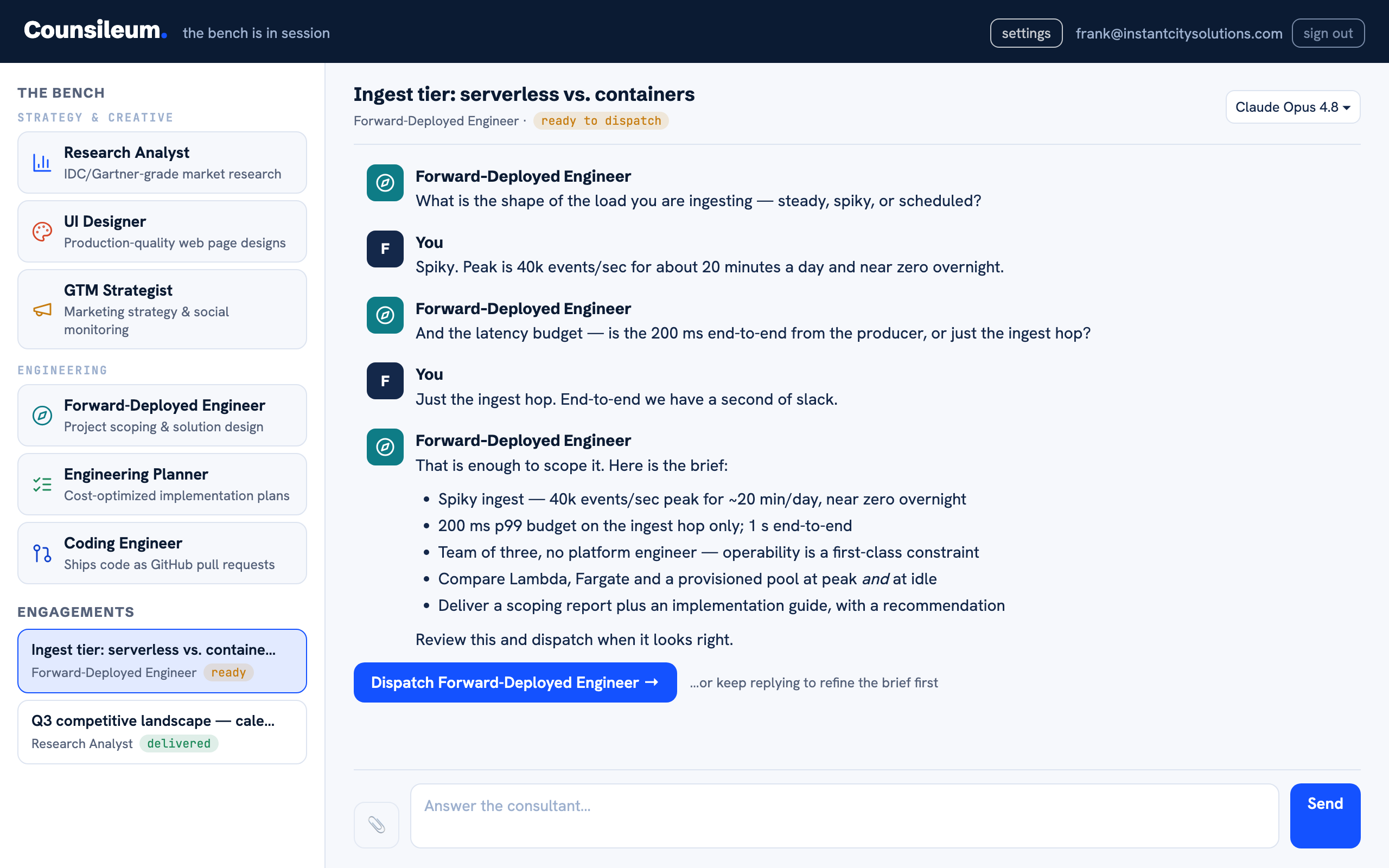
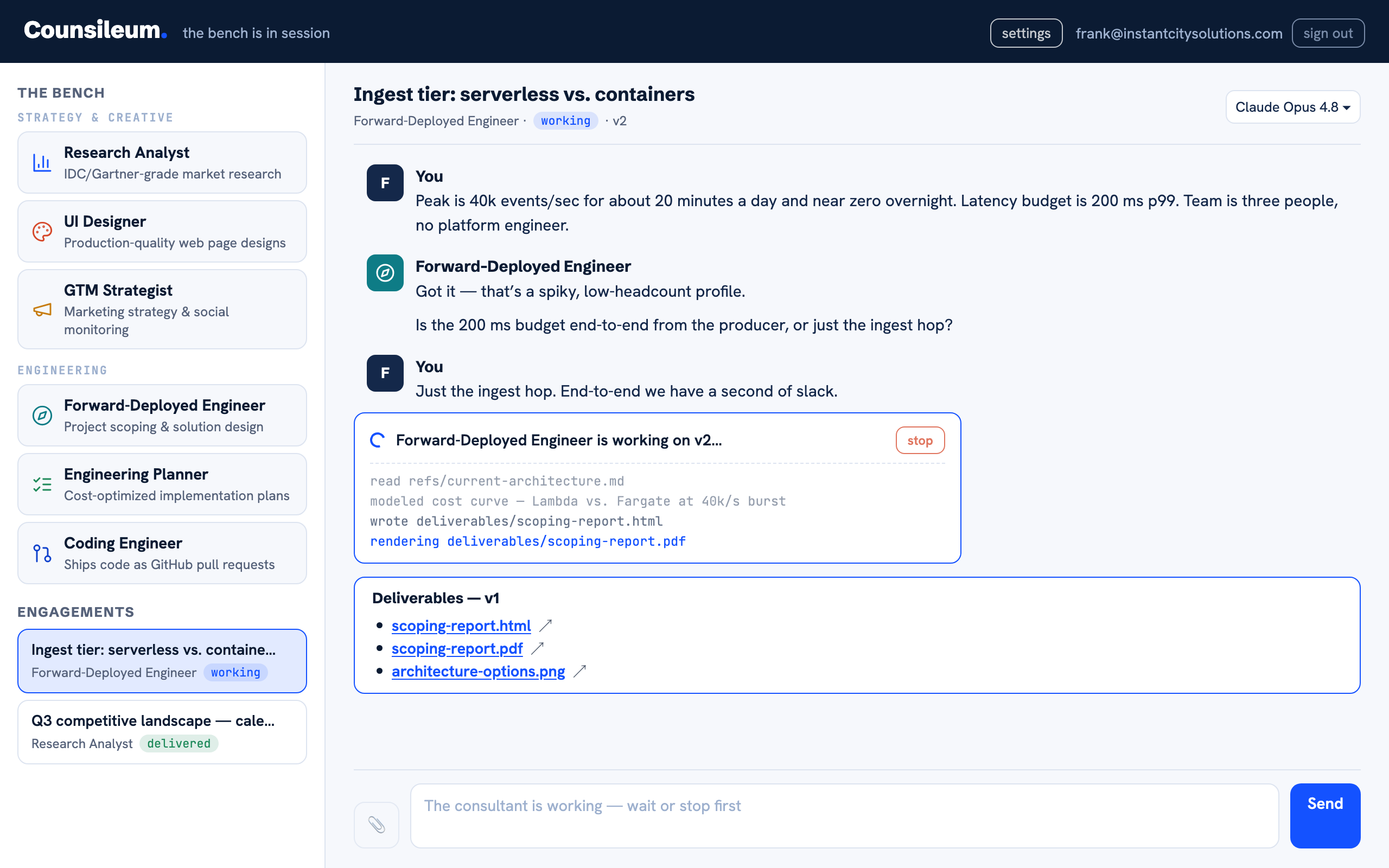
The Counsileum app: the bench of consultants on the left, an engagement running on the right with its live activity feed and published deliverables.

What Counsileum is

Counsileum is an on-demand AI consultancy: a standing bench of nine specialist consultants that each return a finished deliverable — a research report, a costed plan, a vendor scorecard, a deck, or a pull request — usually within the hour. You brief one consultant in plain language, answer a short intake interview, and dispatch.

Who it is for
Founders, product leaders, corporate strategy teams and technical leaders who need analyst-grade work faster than a research subscription or a consulting SOW can deliver it.
What makes it different
The output is the artifact itself, not a chat transcript or a summary. Every engagement ends in a file you can send, present, or merge.
How you engage
One consultant, one brief, one deliverable — direct consulting scoped to your question, with no retainer and no statement of work.
Typical turnaround
Minutes to an hour for research, plans, scorecards and decks; longer for engineering work that ends in a pull request.
The bench

Nine specialists. Every one delivers a real artifact.

Brief the one you need. Each works like a colleague you handed a scope to — not a chatbot you have to supervise.

Strategy & creative

Research Analyst

Deep market research, Gartner-grade.

report · PDF

UI Designer

Designs the page, in real HTML.

live design

GTM Strategist

Positions it, drafts the posts.

GTM strategy

Product & Brand Strategist

Pressure-tests the idea, names it.

concept · mockup

Deck Producer

Turns a brief into branded slides.

16:9 deck
Engineering

Forward-Deployed Engineer

Scopes the project end to end.

scoping report

Engineering Planner

Costs the work, model by model.

costed plan

Coding Engineer

Ships code and opens the pull request.

pull request

Context Engineer

Teaches your coding agent any stack.

context.md · llms.txt
How it works

Brief. Interview. Dispatch. Inbox.

Four moves, and only two of them are yours.

01

Brief

Pick a consultant from the bench and describe what you need in a couple of sentences.

02

Interview

The consultant asks a handful of sharp intake questions — one at a time — then plays the scope back to you.

03

Dispatch

Approve, and it works autonomously in its own workspace. Close the tab; nothing depends on your browser.

04

Inbox

The deliverable links land in your email. Reply in the portal with feedback and get a revised version.

The intake

It asks before it works.

Every engagement opens with a short interview — one question at a time, the ones a good consultant asks before quoting. When the scope is clear it plays the brief back for you to approve.

  • Four to six questions, never a form
  • Nothing runs until you dispatch
  • Attach files or point it at a repo
intake — ready to dispatch
An intake interview in the app: the consultant's questions, the client's answers, and the agreed brief with a dispatch button.
The deliverable

You don't get answers. You get artifacts.

Work comes back as the finished thing — a designed report you can send to a board, a deck you can present, a pull request you can merge. Read it in the app, or open the emailed link on your phone.

  • Every version kept and re-emailed
  • Reply to revise — same consultant, same context
  • HTML and PDF, on brand, every time
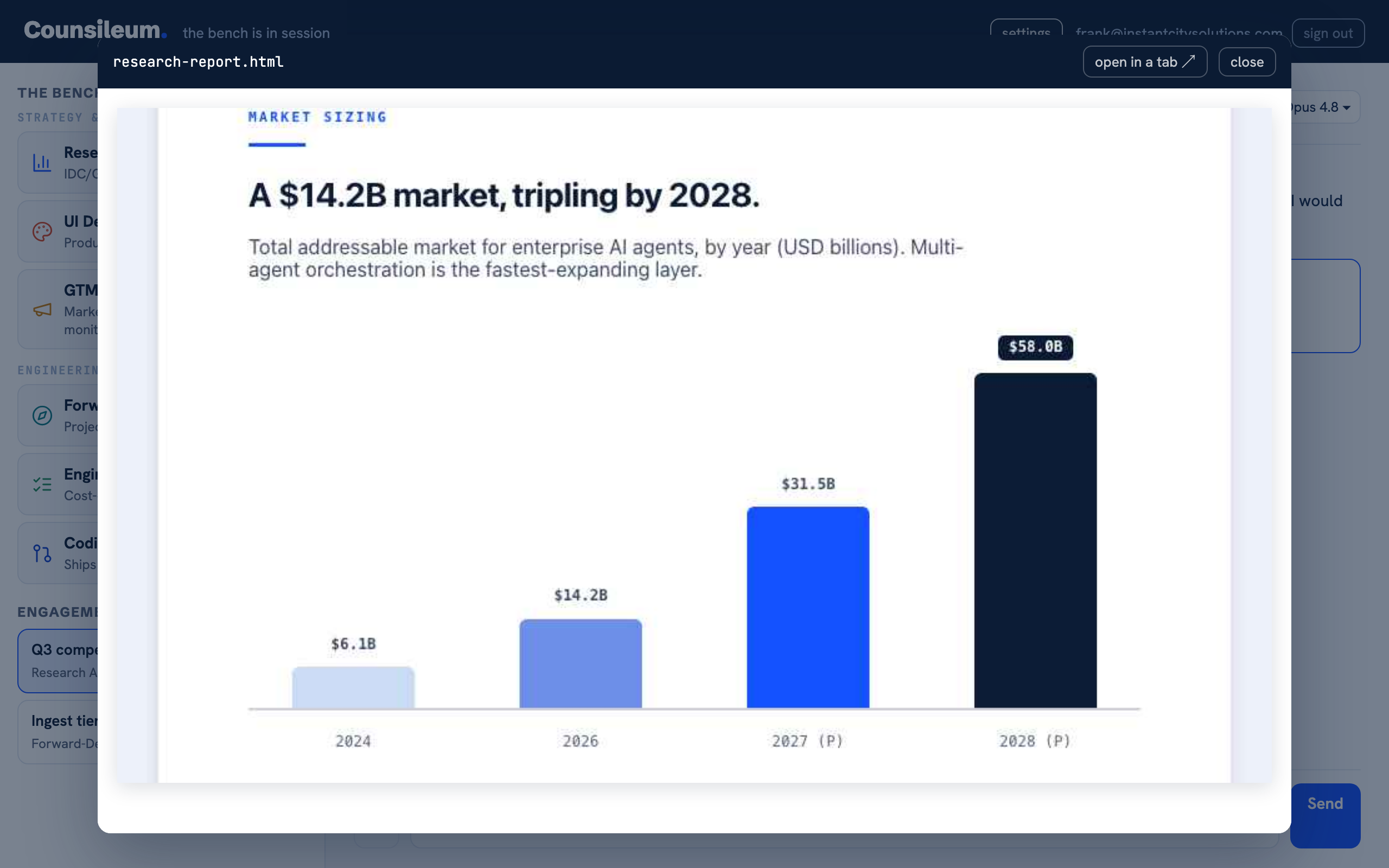
research-report.html
A finished research report open in the app's deliverable viewer, showing a market-sizing chart.
Deliverables

What lands in your inbox.

Research reports

Structured, sourced, board-ready — web and PDF.

Pull requests

Real code on a branch in your own repo.

Costed plans

Scoped work, priced by the cheapest capable model.

Branded decks

On-brand 16:9 slides from a one-line brief.

Vendor scorecards

Weighted to your criteria, sourced cell by cell.

Where we fit

Counsileum vs. a traditional consultancy.

A consulting firm is the right call for long, ambiguous, politically sensitive programmes. It is the wrong call when you need one specific question answered by Thursday — scoped, costed and delivered without a statement of work.

  Traditional consultancy Counsileum
What you buy A statement of work, scoped and staffed One engagement, one deliverable, on demand
Turnaround Two to eight weeks after the SOW is signed Minutes to an hour for most reports and plans
How specific it gets Fully bespoke Fully bespoke — your market, your constraints, your repo
Output A deck and a findings document A report, a deck, a costed plan, or a merged pull request
Revisions Change request, usually billable Reply with feedback; a new version is produced
Best for Long, ambiguous, politically sensitive programmes Decisions you need to make now, with the work shown

We do direct consulting for one client at a time — and we tell you which of our findings are sourced and which are inference.

Vendor evaluation

Your criteria. Your weights. Your shortlist.

A published grid ranks vendors for a buyer who isn't you. It can't know your budget, your stack, your data-residency rules, or the two vendors you ruled out in week one. So we build the scorecard around the decision you're actually making.

  • You set the criteria and the weights. We score against them and show the arithmetic.
  • Only your shortlist gets scored — not every vendor in a market you don't buy from.
  • Every cell carries its source. Anything we can't verify is marked as such, never guessed.
  • Dated on delivery and cheap to re-run when pricing, limits or the shortlist move.
  • Yours alone. We don't publish rankings and we don't resell your evaluation.
Scope an evaluation →
Ingest platform — weighted scorecard v1 · illustrative
Criterion Weight Vendor A Vendor B Vendor C
Data residency (EU)25%545
Cost at 40k events/sec20%352
SSO + SCIM15%553
Migration effort20%244
Support SLA20%435
Weighted total100%3.804.153.90

Scores 1–5 against your criteria. Vendor B wins on your weights — not on ours.

Engagements

Three ways people use the bench.

Every engagement is scoped in the intake interview before anything runs, so you always know what you are getting back.

Single engagement

The one-off answer

You have one question and a deadline. Brief one consultant, get one artifact.

  • A market landscape or sizing study
  • A vendor evaluation scorecard
  • A board deck from a rough brief
  • Unlimited revision rounds on the deliverable
Brief a consultant
Most common

The standing bench

A team that keeps needing research, plans and decks — without keeping analysts on payroll.

  • All nine specialists available continuously
  • Engagements run in parallel
  • Every deliverable in your brand
  • A searchable archive of past work
Talk to us
Engineering

Scope to shipped

A build that needs scoping, costing, and then actually writing — handed between three consultants.

  • Forward-Deployed Engineer scopes it
  • Engineering Planner costs it per model
  • Coding Engineer opens the pull request
  • Work lands on a branch in your GitHub org
Scope a build
From the bench

How this work is actually done.

The frameworks our consultants use, written out in full — vendor grids, market sizing, evaluation scorecards, build-versus-buy.

All articles →
AI integration

The forward-deployed engineer, and why AI integration needs one

The hard part of an AI project is never the model — and what is hard can only be learned from inside the customer's workflow.

12 min read
Vendor evaluation

Magic Quadrant vs. Forrester Wave vs. IDC MarketScape

Three grids, three different questions. What each one actually measures, and which to cite in which argument.

12 min read
Research

How to write an analyst-grade research report

The nine-part structure every credible market report shares, and the sourcing discipline that makes it defensible.

11 min read
Market sizing

TAM, SAM and SOM without the hand-waving

Top-down versus bottom-up sizing, why the two must reconcile, and how to show your arithmetic.

10 min read
Procurement

Building a vendor evaluation scorecard that survives scrutiny

Weighted criteria, anchored scales, and the failure modes that turn a scorecard into a rubber stamp.

11 min read
Questions

The ones people ask before the first brief.

Can you do a vendor evaluation instead of buying a syndicated grid?

Yes — it's one of the most common engagements. A published grid ranks vendors for a generic buyer, so it can't account for your budget, your stack, your data-residency rules, or the vendors you've already ruled out. We build the scorecard around your criteria and your weights, score only the vendors on your shortlist, and show the arithmetic. Every cell carries its source, and anything we can't verify is marked rather than guessed. The evaluation is yours alone. One honest caveat: if what you need is an independent third party to cite in a board paper, buy the syndicated report — a custom scorecard is for making the decision, not for transferring the risk of it.

How long does an engagement take?

Most research reports, plans, scorecards and decks come back within minutes to an hour of dispatch. Engineering work that ends in a pull request depends on the size of the change. The intake interview gives you an estimate before anything runs, and you can close the tab once you have dispatched; nothing depends on your browser staying open.

What exactly do I get back?

A finished artifact, not a chat transcript. Depending on the consultant: a designed research report as both web page and PDF, a 16:9 presentation deck, a costed implementation plan, a scoping document, a self-contained HTML design, a context.md file for your coding agent, or a pull request on a branch in your own GitHub repository. Links are emailed to you and stay live.

Can I ask for changes after the deliverable arrives?

Yes. Reply in the portal with feedback and the same consultant revises the same deliverable with the full context of the engagement still loaded. Each revision is kept as a new version, and the previous ones stay reachable — so you can compare, or roll back to what you had.

How do you handle sourcing and accuracy?

Research deliverables separate what is sourced from what is inferred. Figures carry their provenance, and modelled numbers are shown with the arithmetic that produced them rather than presented as findings. Where a market has no reliable public data, the report says so instead of filling the gap. You should still review a report before you act on it — the same way you would review work from a junior analyst.

Does the Coding Engineer get access to my repository?

Only the repositories you nominate, using a GitHub token you supply and can revoke at any time. Work happens on a dedicated branch, never on your default branch, and arrives as a pull request for your team to review and merge. Nothing is pushed to production and nothing is merged on your behalf.
Work with us

The bench is in session.

Deliverables, not chat transcripts. Every engagement ends with something you can ship, send, or merge. Tell us what you need — we'll come back with a proposal and next steps.